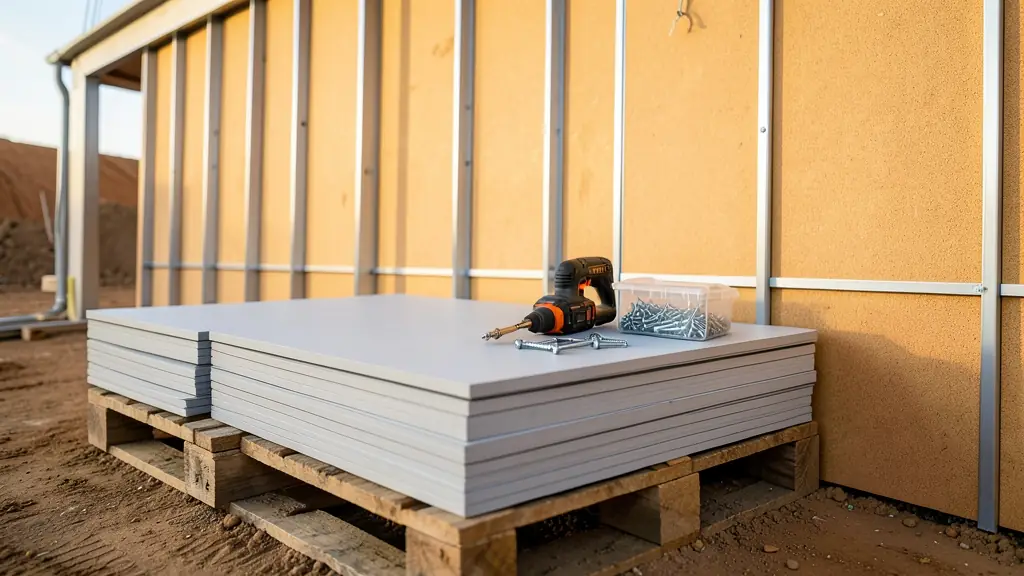
Fibre cement boards, often called nutec boards after a well known product, are sold in sheets 1,200 mm wide and 2.4 m, 2.7 m or 3.0 m long. To clad a building you need enough boards to cover the walls without joins across the height, plus some for cutting around doors and windows and for breakage. This calculator counts them for the outside, the lining inside or both, adds cover strips for the joins and prices the result from published South African board prices.
How the count works
The wall area is the perimeter times the wall height, less the doors and windows. A board covers 1.2 m times its length, so the area divided by the board area gives the bare count, and the waste allowance (10% is usual, 15% with many openings or gables) covers offcuts and breakage. If the wall is taller than the board, you need a horizontal join with a flashing, so choose a board at least as long as the wall is high.
Cover strips go over each vertical join outside: roughly one per board along the walls, plus one at each corner. Inside, joins are usually taped or covered with beads instead.
Which thickness
| Thickness | Common use |
|---|---|
| 4 to 6 mm | Ceilings, soffits and inside lining |
| 6 mm | Light outside cladding on close studs, wendy houses |
| 9 mm | Outside walls of homes and rental rooms, more knocks and wind |
| 12 mm and up | Heavier walls, floors on joists and high traffic areas |
Published prices in November 2026 ran from about R280 for a 6 mm 1200 x 2400 mm board on sale to about R750 for a 9 mm 3.0 m board. Check the maker's stud spacing and fixing guide for the thickness you buy.
Ordering
Send the board count, the size and thickness and the delivery address to fibre cement board suppliers, or the whole building to nutec house builders. For insulated walls in one panel, compare sandwich panels.